Income Tax Rules 2026: Key Changes, New ITR Forms & Exemption Limits
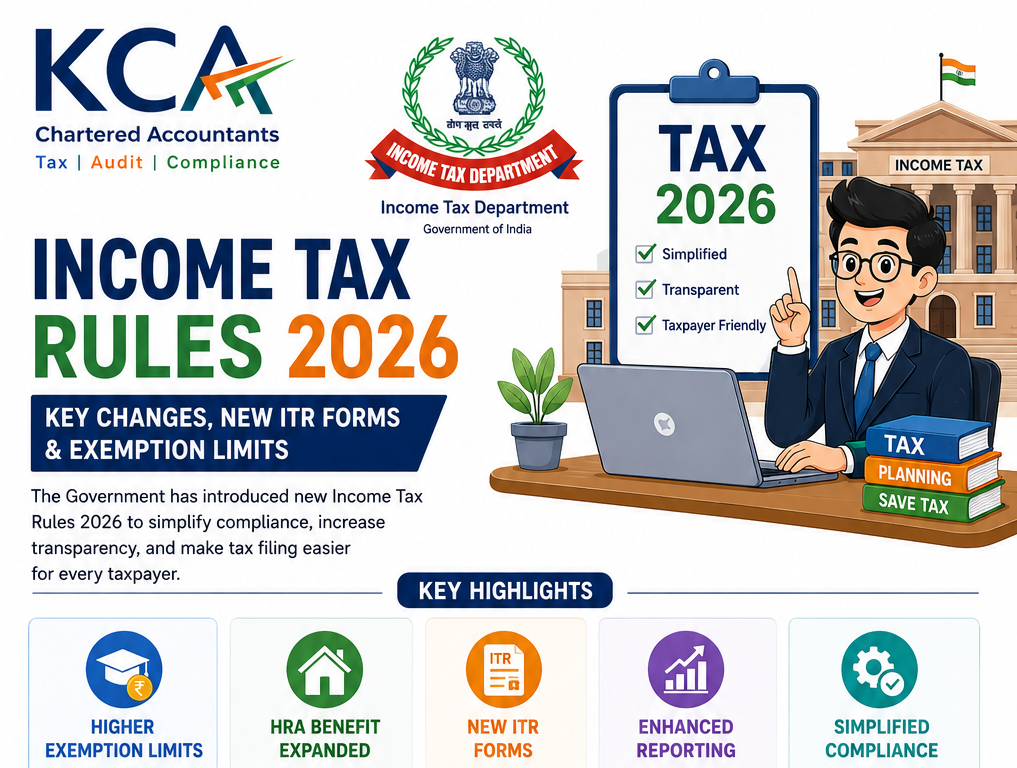
India’s income tax system is set for a major transformation from April 1, 2026, with the implementation of the new Income Tax Act 2025 and Income Tax Rules 2026. The government has introduced simplified compliance procedures, revised exemption limits, updated ITR forms, and enhanced digital reporting requirements to make tax filing more transparent and taxpayer-friendly.
For salaried employees, business owners, freelancers, and investors, understanding these new income tax rules is essential before filing Income Tax Returns (ITR) for AY 2026-27.
What Are the Income Tax Rules 2026?
The Income Tax Rules 2026 replace the old Income Tax Rules, 1962 and will apply from Tax Year 2026-27 onwards. These rules are designed to:
- Simplify tax compliance
- Increase digital reporting
- Reduce procedural complexity
- Improve transparency in tax filing
- Expand automation and pre-filled ITR data
The new framework also introduces updated exemption limits, revised PAN requirements, and newly renamed income tax forms.
Major Changes in Income Tax Rules 2026
1. Higher Exemption Limits for Salaried Employees
One of the biggest highlights is the increase in tax-free allowance limits under the old tax regime.
|
Allowance |
Old Limit |
New Limit (2026) |
|
Children Education Allowance |
₹100/month |
₹3,000/month |
|
Hostel Allowance |
₹300/month |
₹9,000/month |
|
Meal Allowance |
₹50 per meal |
₹200 per meal |
|
Non-cash Gifts |
₹5,000/year |
₹15,000/year |
These changes are expected to provide relief to salaried taxpayers and better align exemptions with inflation and modern living costs.
2. HRA Exemption Expanded to More Cities
The 50% House Rent Allowance (HRA) exemption category has now been extended to:
- Bengaluru
- Pune
- Hyderabad
- Ahmedabad
Earlier, only Delhi, Mumbai, Chennai, and Kolkata were eligible for the higher HRA exemption limit.
3. New Income Tax Forms Introduced
Several commonly used tax forms have been renamed under the Income Tax Rules 2026.
|
Old Form |
New Form |
|
Form 16 |
Form 130 |
|
Form 16A |
Form 131 |
|
Form 26AS |
Form 168 |
|
Form 15G & 15H |
Combined into Form 121 |
|
Form 24Q |
Form 138 |
|
Form 26Q |
Form 140 |
These changes aim to standardize tax documentation and simplify compliance procedures.
Key Changes in New ITR Forms for AY 2026-27
The Income Tax Department has also updated ITR-1, ITR-2, ITR-3, and ITR-4 forms with enhanced disclosures and reporting requirements.
Important Changes Include:
Enhanced Capital Gains Reporting
Taxpayers now need to provide more detailed reporting for:
- Long-term capital gains (LTCG)
- Share buyback losses
- Equity and mutual fund gains
F&O and Intraday Trading Disclosure
Separate reporting requirements have been introduced for:
- Futures & Options (F&O)
- Intraday trading income/losses
Foreign Asset Reporting
Resident taxpayers holding foreign assets or foreign income must provide additional disclosures.
Secondary Address Field Added
A new “secondary address” section has been added in updated ITR forms.
New Income Tax Regime & Exemption Limit
The government continues to promote the new tax regime as the default option.
Proposed New Tax Slabs
|
Income Range |
Tax Rate |
|
Up to ₹3 lakh |
Nil |
|
₹3 lakh – ₹6 lakh |
5% |
|
₹6 lakh – ₹9 lakh |
10% |
|
₹9 lakh – ₹12 lakh |
15% |
|
₹12 lakh – ₹15 lakh |
20% |
|
Above ₹15 lakh |
30% |
Additionally, rebate benefits under Section 87A may make income up to ₹12 lakh effectively tax-free for eligible taxpayers.
Who Can Use Which ITR Form in AY 2026-27?
ITR-1 (Sahaj)
Applicable for:
- Salary income
- One house property
- Income up to ₹50 lakh
- LTCG under Section 112A up to ₹1.25 lakh
Not applicable for:
- Directors in companies
- Foreign assets/income holders
- Short-term capital gains cases
ITR-2
Applicable for:
- Multiple house properties
- Capital gains
- Income above ₹50 lakh
ITR-3
Applicable for:
- Business or professional income
- Traders and freelancers
ITR-4 (Sugam)
Applicable for:
- Presumptive taxation under Sections 44AD, 44ADA, 44AE
PAN Quoting Rules Revised
The new rules also revise PAN quoting thresholds for various transactions.
|
Transaction |
Old Limit |
New Limit |
|
Property Transactions |
₹10 lakh |
₹20 lakh |
|
Hotel/Restaurant Cash Payments |
₹50,000 |
₹1 lakh |
|
Vehicle Purchase |
All vehicles |
Above ₹5 lakh |
Impact on Taxpayers
Salaried Employees
- Higher exemptions under old regime
- Simplified ITR filing
- Better digital integration
Businesses & Professionals
- Increased reporting obligations
- Digital bookkeeping emphasis
- Enhanced TDS/TCS compliance
Investors & Traders
- More detailed capital gains disclosures
- Separate reporting for F&O and intraday trading
NRIs
- Stricter foreign asset disclosures
- Improved compliance tracking
Final Thoughts
The Income Tax Rules 2026 represent one of the biggest overhauls of India’s tax system in decades. While the government aims to simplify compliance and increase transparency, taxpayers will need to adapt to:
- New ITR forms
- Revised reporting requirements
- Updated exemption limits
- Enhanced digital tax monitoring
Choosing between the old and new tax regime will become even more important in AY 2026-27, especially for salaried taxpayers claiming deductions and exemptions.
Staying updated and filing the correct ITR form on time will help taxpayers avoid penalties and maximize tax savings.