
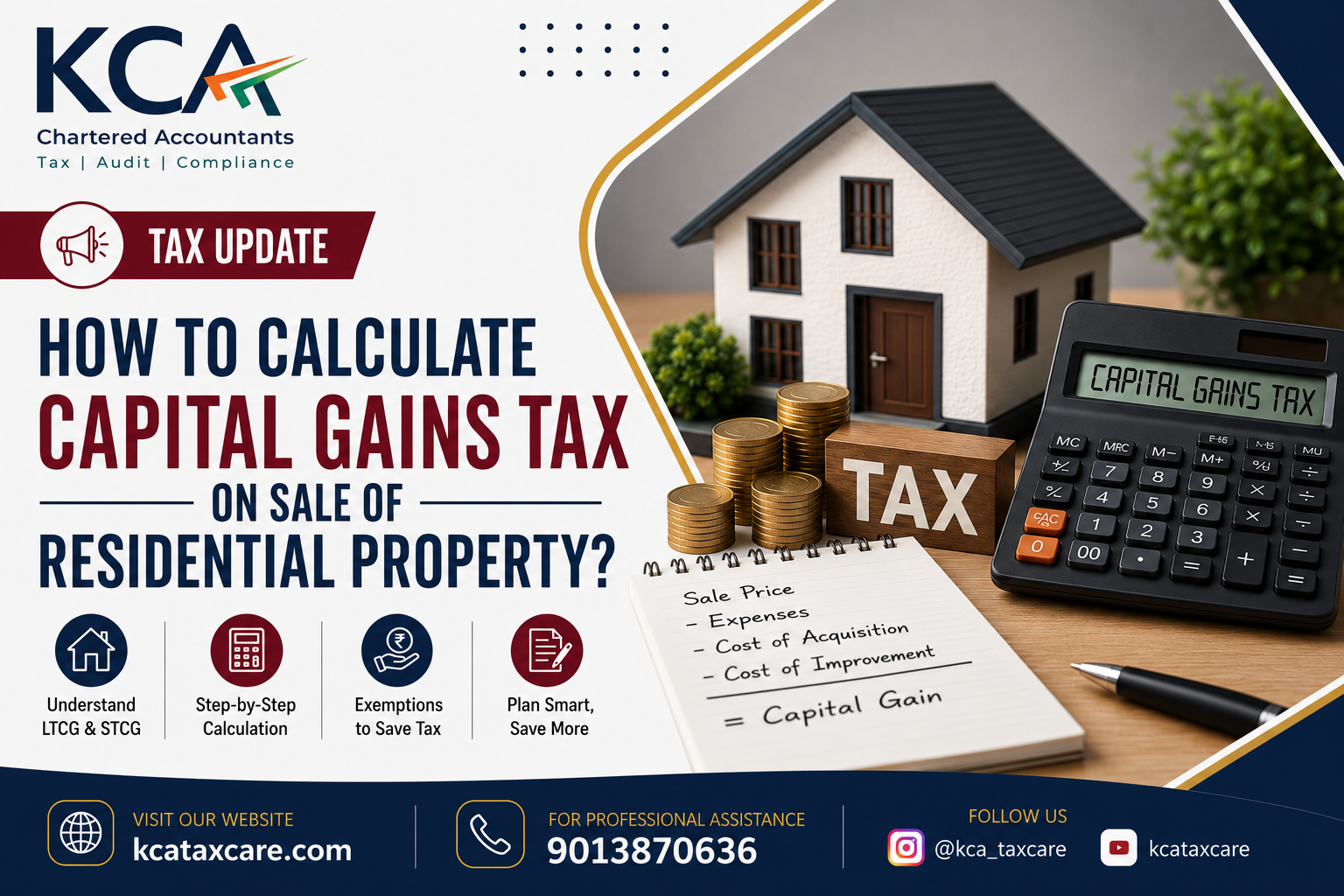
How to Calculate Capital Gains Tax on Sale of Residential Property in India – Complete Guide for FY 2026-27
The sale of a residential property is often one of the most significant financial transactions undertaken by an individual. However, along with the profit earned from such a transaction comes the responsibility of understanding and complying with the capital gains tax provisions under the Income-tax Act, 1961.
Whether you are selling a self-occupied house, an inherited property, or an investment property, the calculation of capital gains tax requires careful consideration of several factors, including the period of holding, cost of acquisition, cost of improvement, transfer expenses, and available exemptions.
This comprehensive guide explains the concept of capital gains on residential property, the method of computation, applicable tax rates, and various tax-saving provisions available under the Income-tax Act. The gain is generally computed by deducting the cost of acquisition, cost of improvement, and transfer expenses from the sale consideration. The tax treatment differs depending on whether the property qualifies as a short-term or long-term capital asset.
Understanding Capital Gains on Residential Property
Capital Gain refers to the profit arising from the transfer of a capital asset. A residential house property, whether self-occupied or rented, is treated as a capital asset under the Income-tax Act.
When such property is sold, the profit earned is taxable under the head "Capital Gains." The nature of taxation depends upon the period for which the property was held before its transfer.
Classification of Capital Assets
Short-Term Capital Asset
A residential property is considered a Short-Term Capital Asset if it is held for 24 months or less immediately preceding the date of transfer.
Any profit arising from the sale of such property is treated as Short-Term Capital Gain (STCG) and is taxable at the normal slab rates applicable to the taxpayer.
Long-Term Capital Asset
A residential property held for more than 24 months before its transfer is regarded as a Long-Term Capital Asset.
The gain arising from its transfer is treated as Long-Term Capital Gain (LTCG) and is taxable at the rates prescribed under Section 112 of the Income-tax Act. For transfers on or after 23 July 2024, LTCG is generally taxable at 12.5% without indexation, while certain resident individuals and HUFs may opt for 20% with indexation for eligible older properties if beneficial.
Components Required for Capital Gain Computation
Before calculating capital gains, the following figures should be determined:
1. Full Value of Consideration
The sale price received or receivable by the seller upon transfer of the property.
2. Cost of Acquisition
The amount originally paid to acquire the property, including registration charges and stamp duty.
3. Cost of Improvement
Expenses incurred towards structural improvements, renovation, or additions to the property.
4. Transfer Expenses
Expenses incurred wholly and exclusively in connection with the transfer, such as:
- Brokerage or commission
- Legal and professional fees
- Advertising expenses
- Documentation charges
- Stamp paper expenses related to transfer
Calculation of Short-Term Capital Gain
Formula
Short-Term Capital Gain = Sale Consideration – Transfer Expenses – Cost of Acquisition – Cost of Improvement
For Example:
|
Particulars |
Amount (₹) |
|
Sale Consideration |
75,00,000 |
|
Less: Transfer Expenses |
1,50,000 |
|
Net Sale Consideration |
73,50,000 |
|
Less: Cost of Acquisition |
55,00,000 |
|
Less: Cost of Improvement |
3,00,000 |
|
Short-Term Capital Gain |
15,50,000 |
The amount of ₹15,50,000 shall be added to the taxpayer's total income and taxed according to the applicable income tax slab rate.
Calculation of Long-Term Capital Gain
Formula
Long-Term Capital Gain = Sale Consideration – Transfer Expenses – Cost of Acquisition/Indexed Cost (where applicable) – Cost of Improvement/Indexed Cost (where applicable) – Exemptions
For properties eligible for indexation benefits under grandfathering provisions, the indexed cost is calculated using the Cost Inflation Index (CII).
Capital Gains on Inherited Property
In the case of inherited, gifted, or ancestral property, the period of holding of the previous owner is also considered while determining whether the asset is short-term or long-term. The cost incurred by the previous owner is generally taken as the cost of acquisition for capital gains computation.
Exemptions Available for Saving Capital Gains Tax
Section 54 – Investment in Residential House
An Individual or HUF can claim exemption from LTCG arising from the sale of a residential house by investing in another residential house property within the prescribed time limits.
Section 54EC – Investment in Specified Bonds
Long-term capital gains can also be exempt by investing in specified bonds issued by NHAI, REC, or other notified institutions within six months from the date of transfer, subject to a maximum investment limit of ₹50 lakh.
Capital Gains Account Scheme (CGAS)
Where the amount cannot be invested before filing the income tax return, it may be deposited under the Capital Gains Account Scheme to preserve eligibility for exemption.
Tax Rates Applicable on Sale of Residential Property
|
Nature of Gain |
Tax Treatment |
|
Short-Term Capital Gain |
Taxable as per applicable slab rates |
|
Long-Term Capital Gain |
12.5% without indexation (subject to applicable provisions) |
|
Eligible grandfathered properties |
Option of 20% with indexation or 12.5% without indexation, whichever is more beneficial |
Conclusion
The computation of capital gains on the sale of residential property involves much more than simply deducting the purchase price from the sale value. Proper consideration must be given to transfer expenses, improvement costs, inherited ownership, and the exemptions available under Sections 54 and 54EC. A well-planned transaction can significantly reduce tax liability while ensuring full compliance with the Income-tax Act.
If you are planning to sell a residential property and require assistance in capital gains calculation, tax planning, valuation, or exemption claims, the experts at KCA Tax Care can help you navigate the process efficiently and maximize available tax benefits.